
Signs, Costs and Care Options for Overnight Senior Care in Winnipeg
When Do Seniors Need Overnight Care?
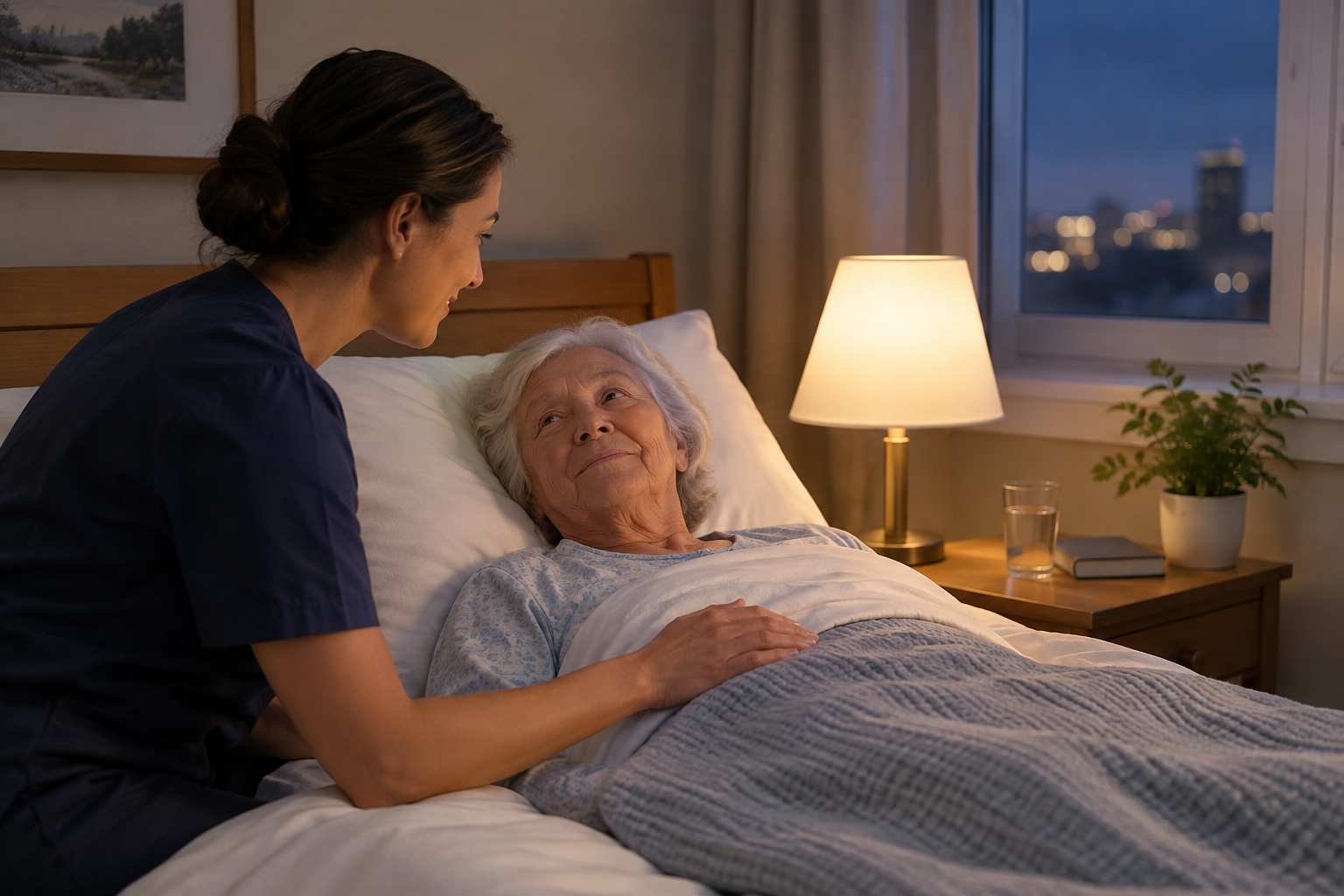
Most seniors need overnight support once one of a few specific things starts happening after dark: a fall or a near-fall getting to the bathroom, wandering or sundowning that peaks in the evening, a medical condition that needs monitoring through the night, or a family caregiver who is no longer sleeping because they are listening for trouble down the hall. Overnight senior care fills that specific gap, either with a caregiver who stays awake through the night or one who sleeps on site and is available if something happens. It is usually a narrower, more affordable step than full 24-hour live-in care, and it is often the difference between a senior staying safely at home and a move that nobody in the family actually wanted yet.
Daytime home care gets most of the attention because it is easiest to picture — help with breakfast, a walk, a ride to appointments. But a lot of the real risk in aging at home happens after the lights go out, when a senior is alone, half-asleep and moving without anyone nearby. This guide sets out exactly when overnight care becomes necessary, what the different overnight arrangements look like, and how a Winnipeg family can tell the difference between "we're tired" and "this isn't safe anymore."
What Overnight Care Actually Covers
Overnight care places a trained caregiver in the home during the hours when a senior is normally alone — typically from evening through early morning. Depending on the household's needs, that caregiver either stays awake the entire shift, watching, assisting and responding as needed, or sleeps in the home and wakes for scheduled checks or if the senior calls out. Both are forms of overnight home care for seniors, and the right one depends on how much actually happens during the night, not just on how anxious the family feels about it.
Awake Care, Sleeping Care, or 24-Hour Live-In: What's the Difference?
Families often use "overnight care" and "24 hour care for seniors" as if they mean the same thing. They don't, and picking the wrong one either overpays for supervision that isn't needed or underpays for supervision that is. The table below lays out the three main arrangements side by side.
| Arrangement | Caregiver status | Best suited for | Typical shift length |
|---|---|---|---|
| Awake overnight care | Awake and alert the entire shift | Frequent night waking, wandering, high fall risk, active medical monitoring | 8–12 hours |
| Sleeping overnight care | Sleeps on site, wakes for checks or calls | Occasional night needs, reassurance, someone present in case of an emergency | 8–12 hours |
| 24-hour live-in care | Caregiver lives in, works days, rests overnight with backup coverage | Seniors needing near-constant support around the clock, not just at night | 24 hours, multi-day rotation |
Most families start with a sleeping overnight caregiver and move to an awake arrangement only if night-time needs turn out to be more frequent than expected. A short trial period with the agency is the easiest way to find out which one actually fits.
The Clearest Signs a Senior Needs Overnight Care
Some signs point directly to overnight care for seniors rather than simply more daytime hours. The list below covers the ones that come up most often.
Falls or near-falls at night
Trips to the bathroom in the dark, disorientation on waking, or a fall that happened while the family was asleep.
Wandering or sundowning
Confusion, agitation or an urge to leave the house that gets worse in the evening and into the night.
Incontinence care
Regular night-time changes or hygiene needs that a senior can no longer manage alone.
Medical monitoring
Conditions such as diabetes, COPD, heart failure or a feeding tube that require checks through the night.
Recent hospital discharge
The first nights home after surgery or an illness, when complications are most likely to appear.
Fear of being alone at night
Anxiety, calling family repeatedly after dark, or refusing to sleep unless someone is nearby.
A family caregiver who can't sleep
Waking at every sound, sleeping in short bursts, or physically exhausted from months of broken nights.
A history of getting up unassisted
Getting out of bed without calling for help, despite instructions or a bed alarm.
Why Night-Time Risk Is Different From Daytime Risk
A senior alone at night faces a different set of physical risks than one who is alone in the afternoon, and the numbers back that up. Research following older adults over time found that while only a minority of falls happen at night, a night-time fall is roughly four and a half times more likely to result in a hospital admission than a daytime fall, after accounting for the type of injury and the person's age — largely because reaction time, lighting and help are all worse after dark (Osteoporosis International, night-time falls study). Getting up quickly from bed also carries its own risk: blood pressure that has settled during sleep can drop sharply on standing, causing the lightheadedness that precedes many night-time falls.
For seniors with dementia, evenings bring a separate pattern. The National Institute on Aging describes sundowning as a cluster of symptoms — confusion, agitation, pacing or wandering — that begins in the late afternoon and can continue well into the night, often triggered by fading light, fatigue or a disrupted internal clock (National Institute on Aging — Tips for Coping with Sundowning). A caregiver who is present overnight can redirect that agitation calmly, which is far harder for an exhausted family member to do at 2 a.m.
What an Overnight Caregiver Actually Does
An overnight shift is not just a caregiver sitting in the next room. A typical night of overnight elderly home care includes:
- Assisting with bedtime routines, medication and getting settled safely into bed
- Scheduled or as-needed checks through the night, including help getting to and from the bathroom
- Repositioning for seniors with limited mobility, to reduce the risk of pressure sores
- Monitoring vital signs or medical equipment where a care plan calls for it
- Calm redirection for confusion, agitation or wandering
- Responding immediately to falls, medical events or calls for help
- Preparing an early breakfast and handing off clearly to family or the day caregiver
Overnight Care and Family Caregiver Burnout
Overnight care is often less about the senior's needs and more about protecting the person who has been carrying them. A family caregiver who sleeps with one ear open for months is not sustainable care — it is a slow path to burnout, and burnout tends to show up as irritability, health problems and, eventually, a crisis that forces a faster decision than anyone wanted. Our guide to 12 signs of family caregiver burnout lists the warning signs in detail; broken sleep and constant night-time vigilance are among the earliest ones.
What Overnight Care Costs in Winnipeg
Overnight rates depend on whether the caregiver stays awake or sleeps on site, and on how many nights per week the family needs coverage. As a general guide:
For exact current rates and how hours are typically packaged, see our full breakdown in private home care costs in Winnipeg, and for funding routes, how to pay for home care in Winnipeg.
When Overnight Care Follows a Hospital Stay
The first few nights after a hospital discharge are when complications are most likely to surface — a reaction to a new medication, a wound that needs checking, or simple confusion in an unfamiliar routine. A short block of overnight care during that window catches problems early, rather than after a return trip to the emergency department. Our guide to a safe transition home after hospital discharge covers the first two weeks in full.
How to Decide: A Short Self-Check
Has a fall or near-fall happened at night in the past few months? That alone is usually reason enough to start overnight support.
Does confusion or agitation get worse in the evening? Sundowning that continues into the night is a clear signal.
Is a medical condition being monitored through the night? Diabetes, breathing support or feeding tubes usually call for an awake caregiver.
Is the family caregiver sleeping through the night? If not, that is a caregiving problem as much as a senior-care one.
If more than one of these applies, it's worth booking a short conversation with an agency rather than waiting for a bigger incident to force the decision. A written care plan can also flag broader signs worth watching for — see our guide to 15 signs your loved one needs home care for the fuller picture beyond overnight hours.
The one-line takeaway: Overnight care becomes necessary the moment night-time risk — a fall, wandering, a medical need, or a caregiver who can't sleep — outweighs the cost and disruption of arranging it, and for most families, that point arrives earlier than they expect.
Overnight Senior Care — Common Questions
Related Guides for Winnipeg Families
Not Sure If It's Time for Overnight Care?
Our team can walk through your family's situation, explain what an awake or sleeping overnight caregiver would look like, and build a plan around exactly the hours you need.
Explore Overnight Care Email Us