
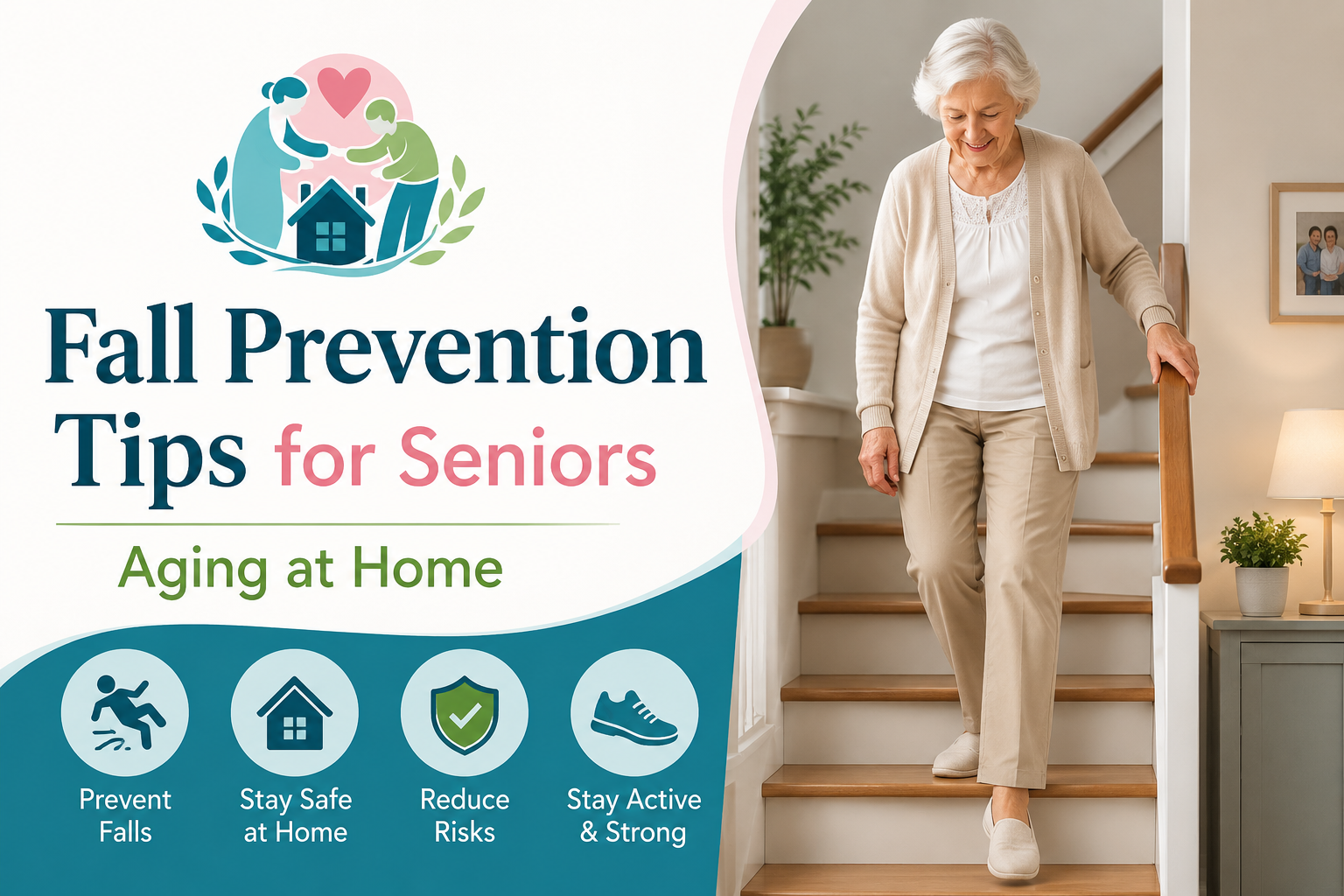
If you have ever watched a parent grip the wall when they thought you were not looking, or noticed a sibling hesitate at the top of the stairs, you already know this worry. Falls do not announce themselves. They happen in familiar places — the bathroom, the kitchen, the hallway — and the consequences can be serious enough to change everything. A hip fracture, a head injury, a long stretch of recovery that pulls a senior out of the home they have spent decades in.
The difficult part is that most families only start thinking about fall prevention after something has already gone wrong. This guide is for the ones who want to get ahead of it — adult children managing care from a distance, spouses quietly carrying the worry, and seniors themselves who are realistic enough to know that staying safe at home takes more thought than it used to.
Falls are not simply a result of getting older. They are usually the result of a combination of things — physical changes, home hazards, medication effects, and the absence of the right support. That combination is what makes fall prevention so practical to address once you understand what you are actually dealing with.
A note on who this is for: this guide is written for families in Winnipeg and across Southern Manitoba who are trying to help an aging loved one stay safely at home. If you are already considering professional support, our senior home care page explains what that looks like in practice — and our team is always available for a free conversation with no pressure.
What this guide covers
Why seniors fall — and why it is not just about age
The instinct most families have is to blame ageing itself. But that framing is not quite right, and it matters because it leads to the wrong response. Ageing does change the body — balance shifts, muscle mass decreases, reaction time slows, and bones become more fragile. But those changes alone do not cause falls. What causes falls is a set of specific, identifiable risk factors that stack on top of each other until the combination becomes dangerous.
Understanding this changes how you approach the problem. Instead of feeling that falls are inevitable, you start to see them as something you can genuinely reduce — by addressing each contributing factor, one at a time.
The risk factors that matter most are not complicated. Most of them are things you can see, measure, and act on.
- Previous falls — one fall significantly increases the likelihood of another
- Reduced muscle strength, particularly in the legs and core
- Balance and gait problems, including conditions like Parkinson's
- Four or more medications taken daily — a threshold linked to sharply higher fall risk
- Vision changes, especially in low light or on uneven surfaces
- Home hazards — loose rugs, poor lighting, cluttered pathways
- Fear of falling — which causes seniors to move less, weaken further, and fall more
- Rushing — particularly when getting up from sleep or moving quickly to answer the phone
Seniors living with dementia or Alzheimer's disease face an additional layer of risk. Memory and spatial awareness changes mean they may not remember where a step is, or misjudge the distance to a chair. A structured daily routine with a caregiver present during transitions reduces this risk substantially — not by restricting the senior, but by being present at the moments that matter.
The most common home hazards to fix first
If you walk through an older adult's home with fall prevention in mind, you will likely spot several things within the first ten minutes. Most of them have been there so long that nobody notices them anymore. That is exactly the problem — familiarity makes hazards invisible, and invisible hazards are the ones that cause injuries.
The good news is that most home hazards are inexpensive to address. The challenge is usually doing a proper walk-through with fresh eyes, which is harder to do in a space you have been visiting for years.
Remove loose rugs and mats from walking paths
Loose rugs are one of the most common causes of trips and falls in senior homes. The edge catches a foot that does not lift as high as it once did. The fix is simple — remove them, or replace them with non-slip mats that have rubber backing and lie completely flat. Pay particular attention to the kitchen, the bathroom doorway, and the area beside the bed.
Clear walking paths through every room
A coffee table that has always sat in the same spot, a footstool in the TV room, a stack of boxes in the hallway — these become hazards when someone's gait changes or their vision shifts. Every main walking route through the home should be completely clear. This includes the path from the bedroom to the bathroom, which is particularly important at night.
Secure or remove electrical cords from floors
Extension cords, lamp cords, and phone chargers that run across floors are a serious tripping hazard. Route them along walls, tape them down with cord covers, or rethink the layout of the room to eliminate floor-level cords entirely. This is a quick fix that is easy to overlook because the cords blend into the background.
Fix uneven flooring and thresholds between rooms
Even a slight height difference between two floor surfaces — hardwood meeting tile, or a worn carpet edge — can catch a shuffling foot. Walk through the home and feel for any bumps, raised edges, or warped floorboards. These are especially important to address at doorways, which seniors pass through dozens of times each day.
Move frequently used items within easy reach
Reaching overhead or bending down to low cabinets shifts a person's centre of gravity and significantly increases fall risk. Reorganise the kitchen, bathroom, and bedroom so that the things a senior uses every day — dishes, toiletries, medications, clothing — are between waist and shoulder height. This small change removes a risk that happens multiple times daily.
Bathroom safety — the highest-risk room in the house
The bathroom is where most falls in senior homes happen. The combination of wet surfaces, close quarters, and the physical demands of getting in and out of a shower or bath makes it the single most dangerous room in the house for an older adult. If you are going to invest in one area of the home, start here.
Worth knowing: bathroom falls are not only the most common — they are often the most serious. A fall onto tile flooring near hard fixtures like the toilet or tub edge is far more likely to result in a hip fracture or head injury than a fall in a carpeted living room. This is not meant to be alarming, but it does explain why targeted bathroom changes have such a significant impact on overall fall risk.
Grab bars at the toilet and shower
Not towel bars — proper grab bars anchored into wall studs. These should be installed beside the toilet and inside the shower or bath. They give a senior something solid to hold while getting up, lowering down, or steadying themselves on a wet surface. A suction-cup grab bar is not adequate for this purpose.
Walk-in shower or shower chair
Stepping over the edge of a bathtub is one of the highest-risk moments in any senior's day. A walk-in shower eliminates that entirely. Where a tub cannot be removed, a shower bench and handheld showerhead allow a senior to wash while seated, removing the need to balance on one leg at any point during bathing.
Non-slip mats inside and outside the shower
The floor of the shower and the area immediately outside it should both have non-slip matting. Textured adhesive strips work inside a tub or shower base. A non-slip bath mat with rubber backing goes on the floor outside. These mats need to be checked regularly — they lose their grip over time and become a hazard themselves.
Raised toilet seat
Getting up from a low toilet seat requires significant leg strength and balance. A raised toilet seat reduces the range of motion needed, making standing much safer. Combined with a nearby grab bar, this changes one of the most physically demanding daily tasks into a manageable one.
Night light from bedroom to bathroom
Night-time bathroom trips are a high-risk situation — a senior who is disoriented from sleep, in the dark, moving quickly. A motion-activated night light in the hallway and inside the bathroom means they never navigate this path in complete darkness. This is a small, inexpensive change that addresses a very real risk.
Keep the floor completely clear
Shampoo bottles, a spare toilet roll, a bathroom scale, a small bin — these all end up on the bathroom floor and all become trip hazards. Store everything off the floor. A wall-mounted rack or shelf above the toilet keeps things accessible without creating obstacles at foot level.
For seniors who need direct assistance with bathing and bathroom use, having a caregiver present during these moments removes the risk almost entirely. This is one of the core roles of daily home care — a trained caregiver is there during the transitions that matter most, not just for the easier parts of the day. Our guide on what a typical day of home care looks like explains this in more detail.
Bedroom and the bedroom-to-bathroom journey
The bedroom is the second most common location for falls at home. Getting out of bed — especially during the night or early morning — involves a transition from lying flat to standing upright, often while a person is still half-asleep and their blood pressure has not yet adjusted. That adjustment delay, called postural hypotension, causes lightheadedness that can be enough to make someone lose their footing.
A few specific changes to the bedroom make a meaningful difference here.
- Adjust the bed height so the senior's feet rest flat on the floor when sitting on the edge — not dangling, not having to stretch
- Remove any item from beside the bed that could be grabbed for support but is not anchored — a lamp table, a bedside cabinet on casters, a pile of books
- Install a sturdy bed rail or grab bar beside the bed if getting up and down is already difficult
- Keep a telephone or personal alarm within reach of the bed — if a fall does happen, being able to call for help immediately changes the outcome significantly
- Ensure slippers are within reach before standing, and that they have non-slip soles and a closed back — open-backed slippers are one of the most common footwear causes of falls
- Teach the senior the habit of sitting on the edge of the bed for 30 seconds before standing — this allows blood pressure to stabilise and dramatically reduces dizziness on rising
For seniors managing serious illness or recovering from a procedure, the bedroom can become a place where significant care happens throughout the day. Our team provides post-operative home care that covers exactly these transitions — helping seniors move safely between bed, bathroom, and the rest of the home during recovery.
Lighting, flooring, and the hazards people stop seeing
Older eyes need significantly more light than younger ones to see the same thing clearly. A hallway that feels perfectly well-lit to a 40-year-old visitor may feel genuinely dim to a 78-year-old resident. This is not a perception issue — it is a physical reality of how the eye changes with age. The lens thickens, the pupil responds more slowly, and contrast sensitivity decreases. Steps that look obvious in daylight can become invisible hazards in the evening.
❌ What most senior homes have
- Single overhead light in hallways, often with a dim bulb
- No lighting between the bedroom and bathroom
- Stair edges that blend into the surrounding floor
- Light switches only at the top or bottom of stairs
- Glare from uncovered windows during morning light
- Lamps that require walking across a dark room to turn on
✓ What actually reduces fall risk
- Bright LED lighting in all rooms, hallways, and stairs
- Motion-activated night lights along the bedroom-to-bathroom path
- Contrasting tape or strips on each stair edge so steps are clearly visible
- Light switches at both the top and bottom of every staircase
- Adjustable blinds or sheer curtains to manage glare
- Plug-in lamps positioned so no one walks in darkness to reach them
On flooring: carpet is generally safer than hard floors for falls because it provides more grip and is more forgiving when a fall does happen. But worn carpet with curling edges or bubbling sections is more dangerous than hardwood. The surface matters less than the condition. Whatever flooring is in the home, walk through it looking specifically for edges that lift, surfaces that are uneven, or areas that become slippery when wet.
Strength, balance, and keeping the body capable
Physical conditioning is one of the most powerful tools available for reducing fall risk — and one of the most underused. The conversation around senior exercise often focuses on cardiovascular health or weight, which are both important, but for fall prevention specifically, the priorities are different. What matters most is leg strength, core stability, and balance.
The encouraging thing is that these qualities respond well to exercise even at an advanced age. Research shows that targeted strength and balance training reduces fall rates in older adults by 23 to 34 percent — which is a more significant effect than most home modification programmes alone. The body maintains a surprising capacity to strengthen when it is given the right work to do.
Before starting any exercise programme: a senior's GP or physiotherapist should be involved in recommending the right activities based on current health and mobility. This is especially important for anyone recovering from a previous fall, managing a balance condition, or living with heart or joint problems.
The exercises most consistently recommended for fall prevention are not complicated. Tai chi has a particularly strong evidence base — its slow, deliberate movements train balance and proprioception in a way that carries directly into everyday movement. Chair-based exercises for leg strength are accessible even for seniors with limited mobility. And simply walking regularly — at a comfortable pace, in a safe environment — maintains gait patterns and builds the confidence that prevents the fear-of-falling cycle from taking hold.
- Heel-to-toe walking along a hallway — trains balance and gait in a practical setting
- Standing on one leg beside a sturdy surface — even 10 seconds at a time builds balance
- Seated leg lifts and calf raises — strengthens the muscles used in standing and walking
- Sit-to-stand practice from a firm chair — builds the exact movement pattern most needed for safe transfers
- Gentle tai chi or falls-prevention exercise classes — available in Winnipeg community centres and recommended by many GPs
A caregiver who accompanies a senior to exercise appointments, or encourages and assists with gentle home exercises as part of a daily routine, makes a real difference to whether those activities actually happen consistently. Companion home care includes exactly this kind of active, engaged support — it is not just company, it is participation.
Medication and its effect on fall risk
This is a section that families often find surprising, because the connection between medication and falls is not widely discussed outside clinical settings. But it is one of the most significant contributing factors to falls in older adults — and it is one that responds directly to professional management.
As the body ages, it processes medications differently. Drugs stay in the system longer. Side effects that were manageable at 50 become more pronounced at 75. And because many seniors manage multiple conditions simultaneously, they are often taking four, five, or more medications daily. The interactions between those medications — combined with the way older bodies handle them — can cause dizziness, low blood pressure on standing, drowsiness, impaired coordination, and blurred vision. All of these increase fall risk directly.
- Sedatives and sleep aids — cause lingering drowsiness that affects balance and reaction time into the following morning
- Blood pressure medications — can drop pressure too low on standing, causing dizziness
- Diuretics (water pills) — increase urgency and night-time bathroom trips, raising the risk of rushed movement in the dark
- Antidepressants and anti-anxiety medications — affect the central nervous system in ways that influence balance
- Pain medications, including some over-the-counter options — cause cognitive fog and slowed reflexes
The right response is not to stop taking medications — that can be far more dangerous. The right response is a medication review with the prescribing doctor or a pharmacist, specifically asking about fall risk as part of that conversation. Many families have found that a medication review reduces the number of medications a senior is taking, simplifies the schedule, and makes a noticeable difference to their alertness and steadiness.
Consistent medication management — taking the right dose at the right time, every day — also matters enormously. A missed dose, an accidental double dose, or a new medication that has not been properly introduced can all affect stability for days. This is one of the most important practical roles a caregiver plays. Our nursing care at home service provides trained clinical oversight for seniors whose medication needs are complex or whose conditions require monitoring alongside their medications.
Vision, footwear, and the small details that add up
Vision changes are a direct risk factor for falls, and they are often the last thing anyone thinks about. An older adult who squints slightly reading the newspaper, or who struggles with glare on bright days, may have meaningful vision changes that have not been addressed because they seem manageable. The problem is that the same vision changes that make reading slightly harder also make it harder to judge the depth of a step, spot an edge in a dim hallway, or pick up a foot over a threshold confidently.
An annual eye examination is one of the simplest and most effective fall prevention steps a senior can take. If prescription glasses are worn, the prescription should be current. Bifocals or progressive lenses — while excellent for general vision — can distort depth perception on stairs, so some optometrists recommend a separate pair with single-vision lenses specifically for stair use.
Cataracts, which are very common in adults over 70, reduce contrast sensitivity and increase the difficulty of seeing in low light. Cataract surgery, where appropriate, has been shown in several studies to reduce fall risk directly — because vision clarity itself is restored. This is worth a conversation with a GP or ophthalmologist if cataracts have been diagnosed but surgery has not yet been considered.
On footwear — this is an area where well-meaning families sometimes make unhelpful choices. Thick-soled trainers or slippers feel cushioned and comfortable, but they can reduce sensory feedback from the floor, making it harder to detect uneven surfaces. The ideal footwear for a senior at fall risk has a thin, non-slip sole, a firm heel cup, and a closed back. It fits snugly — not tight, but not loose. And it is worn consistently, including indoors. Walking in socks on a smooth floor is one of the simplest hazards to remove.
How a caregiver reduces fall risk every single day
All of the changes above — the home modifications, the exercise, the medication management, the footwear — are meaningful. But there is one element that addresses fall risk more comprehensively than any single modification: consistent human presence during the times of day when falls most commonly happen.
Falls do not cluster randomly throughout the day. They happen at specific moments — getting out of bed, moving to the bathroom, standing up from a chair, carrying something while walking, reaching for something overhead, rushing to answer a door or phone. A caregiver who is present during these transitions does not just catch someone if they stumble. They change the entire dynamic of how those moments happen — the pace, the confidence, the physical support available.
This is different from supervision. A good caregiver does not stand watch from a corner. They walk alongside, offer a steadying arm, suggest the safer route, notice when a senior seems more unsteady than usual, and report changes to the family. Over time, that awareness builds into a picture of what is normal for that individual — which means changes that might signal a medication problem, an infection, or a balance deterioration get noticed early, before a fall happens.
For seniors who live alone, fall risk is significantly higher simply because if something does happen, there is no one there to help. A fall followed by an extended period on the floor before anyone is alerted leads to worse outcomes — not just physically, but psychologically. The fear that follows can reduce a senior's confidence and willingness to move around their own home for months afterward. Regular caregiver visits interrupt that isolation and provide the physical safety net that makes everything else more manageable.
Families across Southern Manitoba — in Winnipeg and smaller communities alike — often tell us that the fall they feared for years finally happened when their loved one was alone and had been reluctant to accept help. That pattern is worth taking seriously before it plays out.
Homecare Evernest provides in-home senior care across Winnipeg and the surrounding region. Whether your loved one needs a few morning visits each week or full-time daily support, care is built around their actual life and routine — not a fixed package.
What to do after a fall has already happened
If you are reading this after a fall has already occurred, the focus shifts. Falls create two challenges simultaneously: the physical injury that may need treatment, and the psychological aftermath that is often just as significant. Both need to be addressed.
On the physical side, even a fall that looks minor should be assessed by a healthcare professional — not just the visible injury, but what may have caused the fall. A fall in a previously steady older adult can be the first sign of a urinary tract infection, a cardiac problem, a medication interaction, or a neurological change. Treating the underlying cause is just as important as treating the injury itself.
The psychological aftermath is harder to manage and often goes unaddressed. A senior who has fallen becomes afraid of falling again. That fear causes them to move less — which weakens the muscles that prevent falls — which makes another fall more likely. It is a cycle that is difficult to break once it takes hold, and it often results in a senior becoming increasingly homebound even when their physical recovery has been successful.
Addressing this requires patience and the right kind of support. Gradual, supervised reintroduction to normal movement — ideally with a physiotherapist and a supportive caregiver — helps rebuild confidence at a pace that feels safe rather than pressured. If the fall has prompted a recovery period at home, post-operative home care or structured rehabilitation support can be arranged to help the senior regain function in their own environment, where their confidence is most likely to return.
For families who were managing care informally before a fall, a fall is often the moment when the conversation about more consistent professional support finally happens. If that is where you are, our team is straightforward to talk to. There is no sales process — just a conversation about what your loved one needs and what options make sense for your family.
Home care for fall prevention across Southern Manitoba
Homecare Evernest provides in-home senior care across Winnipeg and the communities surrounding it. The distance between towns does not change the quality of care — each location is supported by the same team, the same values, and the same commitment to building a genuine relationship between caregiver and senior.
If your loved one is in a smaller community and you are unsure whether care is available there, call us. We cover a wider area than our location pages suggest, and we will be honest about what we can arrange for your specific situation.
Questions families ask about fall prevention and home care
Worried about a parent's safety at home?
Our team will visit, listen carefully, and put together a care plan built around your loved one's actual day — not a generic package. Free consultation, no pressure, no obligation.
Read more family guides on our blog · Explore senior home care in Manitoba · Call us at 204 312 0532