
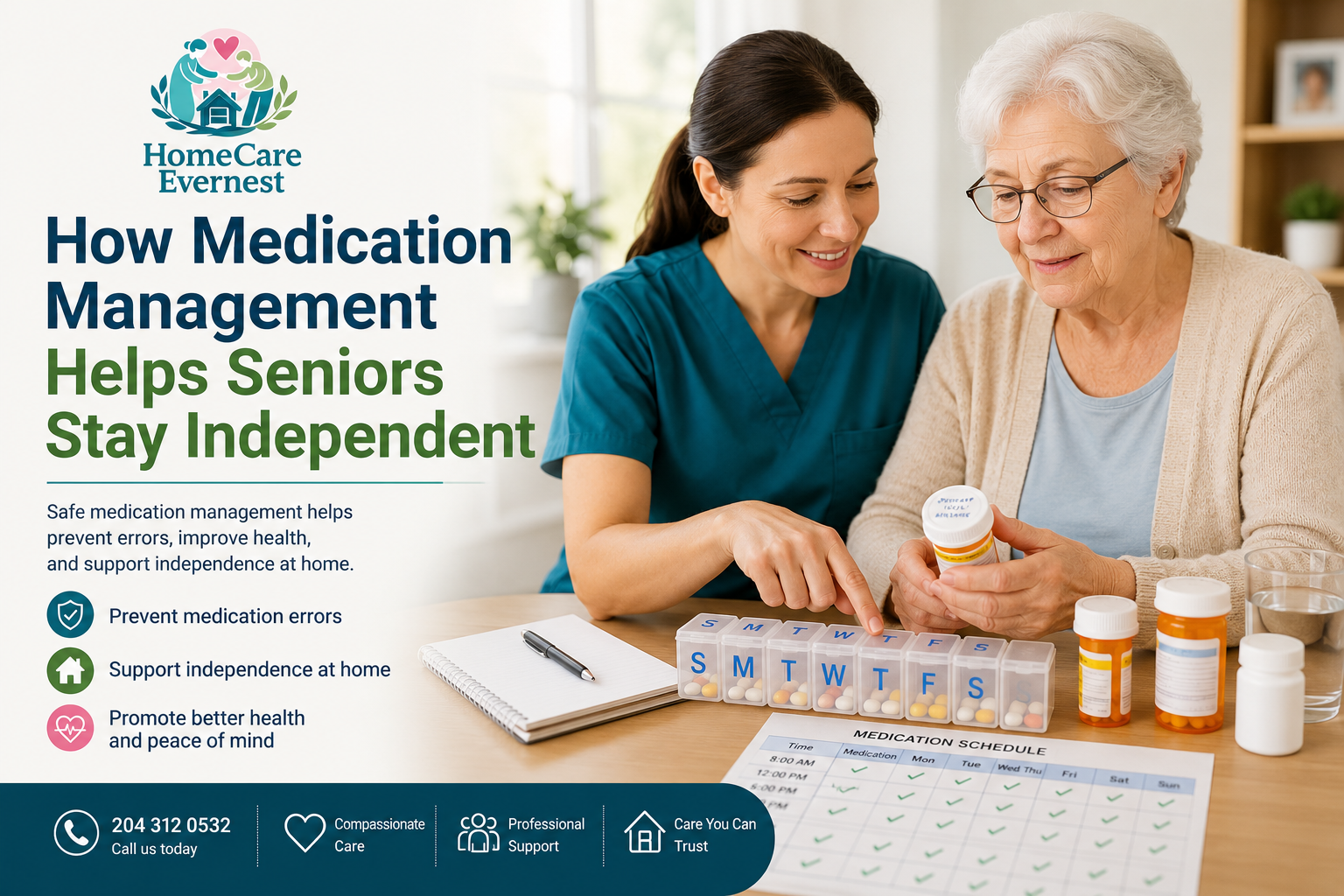
Most seniors do not miss medications on purpose. They miss them because managing multiple prescriptions, multiple schedules, and multiple instructions is genuinely complicated — and it only gets harder as the number of medications increases.
The average older adult in Canada takes five or more prescription medications daily. Many take eight or more. Each medication has its own schedule, its own food interactions, its own storage requirements, and its own set of side effects that can overlap with, or be confused for, other conditions. Managing all of this reliably, every day, alone — is a significant cognitive and organisational task that most families underestimate.
When medication management breaks down — doses missed, doubled, taken at the wrong time, or combined with supplements that interfere — the consequences range from a bad day to a hospital admission. In older adults, medication errors are among the most preventable causes of serious health events. And they are far more common than most families realise until they are dealing with the fallout.
Worth knowing: this guide covers practical medication management for seniors aging at home. If your loved one has a complex health condition, takes a large number of medications, or has already experienced a medication-related health event, a medication review with their GP or pharmacist is a valuable starting point — separate from the daily support covered here.
What this guide covers
Why medication management matters so much for seniors
Getting medication right is not a detail — it is one of the most direct connections between what happens at home every day and whether a senior ends up in hospital.
Older adults metabolise medications differently than younger adults. The kidneys and liver — the organs responsible for processing and clearing drugs from the body — become less efficient with age. This means medications stay in the system longer, reach higher concentrations, and carry greater risk of side effects and interactions than the same dose would in a younger person.
At the same time, the conditions that require medications become more numerous with age. High blood pressure, diabetes, heart disease, arthritis, osteoporosis, depression, and sleep difficulties often occur together — each requiring its own medication, each medication potentially interacting with the others. What begins as two or three prescriptions in a person's fifties can become a daily routine of eight or ten by their late seventies.
The good news is that most medication errors in older adults living at home are preventable. They do not require clinical intervention to avoid — they require consistent, organised, daily support: reminders, preparation, observation, and someone paying attention to changes. That is exactly where structured home care support makes a measurable difference.
The most common medication errors at home
Understanding where medication management most commonly goes wrong is the first step toward preventing it. Most errors fall into a handful of categories — and most are entirely avoidable.
Missed doses
The most common error. Often caused by forgetting, being away from home, or running out of medication before the next refill
Double dosing
Taking a dose, forgetting it was taken, and taking another. Particularly common in seniors with early memory difficulties
Wrong timing
Some medications must be taken at specific times — with food, without food, morning only, or hours apart from others. Incorrect timing reduces effectiveness or increases side effects
Mixing up medications
Multiple tablets of similar appearance taken from disorganised packaging. Easy to confuse, especially with vision or dexterity challenges
Stopping early
Stopping antibiotics or other medications when symptoms improve, before the course is complete. Reduces effectiveness and risks resistance
Unsafe storage
Medications stored in warm or humid environments (like bathrooms) can degrade. Some require refrigeration. Incorrect storage affects potency
A note on over-the-counter medications: many seniors do not count over-the-counter drugs, vitamins, or herbal supplements as "real medications" — but they can interact with prescription drugs in clinically significant ways. Ibuprofen and blood thinners. St. John's Wort and antidepressants. High-dose calcium and certain antibiotics. Always include OTC medications and supplements in any medication review.
Understanding polypharmacy — when more medications means more risk
Polypharmacy — the use of five or more medications simultaneously — is not rare in older adults. It is the norm. And while each medication may be individually appropriate, the combination creates risks that no single prescribing doctor may have fully assessed.
When a senior sees a GP for blood pressure, a cardiologist for heart disease, a rheumatologist for arthritis, and a psychiatrist for depression, each specialist may prescribe appropriately for their area — without full visibility of everything the others have prescribed. No single clinician may own the complete picture of what a senior is taking every day and how those medications interact with each other.
The risks of polypharmacy are real and well-documented. Drug interactions can reduce the effectiveness of one or both medications, increase side effects, or produce entirely new symptoms. Some combinations increase fall risk by causing dizziness or low blood pressure. Others affect cognition in ways that are mistaken for dementia. Others stress the kidneys or liver in ways that accumulate quietly over months before becoming a crisis.
💡 What a medication review actually involves
A formal medication review — conducted by a GP or pharmacist — goes through every medication a senior is taking, including OTC drugs and supplements, and assesses whether each is still necessary, whether the dose is appropriate for age and kidney function, whether any combinations are problematic, and whether any symptoms the senior is experiencing might actually be medication side effects rather than new conditions. In Manitoba, pharmacists can conduct these reviews and flag concerns to the prescribing physician. It is worth requesting one annually for any senior taking five or more medications.
Warning signs that a medication problem may be developing
Many of the signs that something is going wrong with a senior's medications are easy to misattribute to ageing, tiredness, or other conditions. Knowing what to look for makes early intervention much more likely.
Physical warning signs
- Unexplained dizziness or falls — often linked to blood pressure medications
- Unusual fatigue or weakness that appeared gradually
- Nausea, stomach pain, or appetite loss that coincides with a new or changed prescription
- Confusion or unusual cognitive changes — can indicate toxicity
- Bleeding or bruising more easily than usual — possible blood thinner issue
- Constipation or urinary changes — side effects of multiple common medications
- Swelling in the legs or ankles — can indicate medication interaction
Organisational warning signs
- Pill bottles running out faster or slower than expected
- Medications found in unusual places — pockets, countertops, forgotten
- Confusion about which medication is which
- Missed refills or prescriptions not collected from the pharmacy
- Difficulty opening packaging or reading small-print labels
- Multiple pill bottles without a clear system for tracking what has been taken
- Stopping medications because of cost without telling the doctor
If you notice these signs: the right first step is a conversation with the senior's pharmacist or GP — not an adjustment to their medications at home. Even well-meaning changes (halving a dose, skipping a day) can have serious consequences with some medications. Raise concerns and let a health professional guide the response. Our article on 10 early signs your aging parent needs home care support covers medication confusion as one of the key signals families should watch for.
Practical systems that actually help at home
The most effective medication management tools are not complicated. They are simple, consistent systems that remove the need to rely on memory — because memory, especially under the cognitive load of managing multiple health conditions, is the weakest link in any medication routine.
Weekly pill organisers
A seven-day pill organiser, sorted each week by the caregiver or family member, removes the daily decision-making from the senior entirely. They open Monday morning's compartment. That is all. A filled organiser makes it immediately visible whether a dose has been taken — there is nothing in the compartment if it has, and the pills are still there if it has not. This alone prevents most missed and doubled doses.
Medication schedules in plain language
A simple written schedule — on the fridge, on the medication shelf, somewhere visible — that lists each medication, what it looks like, what it is for, when to take it, and whether to take it with food. Written in large, clear font. Not a pharmacy printout with eight pages of small text — a single, laminated card that a senior can read at 7am without searching for their glasses.
| Tool | Best For | Limitation |
|---|---|---|
| Weekly pill organiser | Most seniors — simple, visual, immediately shows if a dose was taken | Needs to be refilled weekly by someone reliable; does not work for liquid or refrigerated medications |
| Medication alarm app or phone reminder | Seniors who are comfortable with smartphones and have good cognition | Does not confirm the dose was actually taken — only that the alarm went off |
| Automatic pill dispenser | Seniors who live alone and need timed dispensing without caregiver support for some visits | Higher cost; requires setup and loading; some models are complex to refill |
| Blister packs from pharmacy | Seniors with complex regimens — pharmacist pre-packs medications in daily strips | Takes 24–48 hours to prepare; requires advance planning for refills |
| Caregiver-managed daily prompt | Seniors with memory difficulties, multiple medications, or recent medication changes | Requires consistent caregiver presence at medication times; most reliable overall method |
Ask your pharmacy about blister packs: many pharmacies in Manitoba will pre-package a senior's medications into clearly labelled daily blister packs at no additional cost, or for a small fee. Each strip is labelled by day and time of day. This eliminates sorting, removes visual confusion between tablets, and makes it immediately obvious whether a dose has been taken. For seniors with complex regimens, this is one of the highest-impact changes a family can make.
Food, drink, and supplement interactions seniors need to know
What a senior eats and drinks can directly affect how their medications work — and most seniors, and many families, do not know about these interactions until something goes wrong.
- Grapefruit and grapefruit juice — interacts with a wide range of common medications including statins, blood pressure drugs, and some heart medications. It inhibits an enzyme that breaks down these drugs, causing blood concentrations to rise unpredictably. Even a single glass can affect drug levels for 24 hours
- Vitamin K-rich foods (spinach, kale, broccoli) — directly affects warfarin (a blood thinner). Sudden large increases or decreases in Vitamin K intake can push warfarin levels dangerously high or low. Consistent intake matters more than avoidance
- Calcium-rich foods and some antibiotics — calcium can bind to certain antibiotics (particularly tetracyclines and fluoroquinolones) and prevent their absorption. These antibiotics typically need to be taken 2 hours before or 6 hours after dairy or calcium supplements
- Alcohol and most medications — alcohol interacts with an extremely broad range of medications, including blood thinners, diabetes drugs, blood pressure medications, and antidepressants. Even moderate alcohol can amplify sedative effects, increase fall risk, and affect drug metabolism significantly in older adults
- St. John's Wort (herbal supplement) — interacts with antidepressants, blood thinners, some heart medications, and many others. Many seniors take it for mood without mentioning it to their doctor, because it is "natural." It is one of the most significant herbal drug interactions in clinical practice
- High-dose fish oil and blood thinners — high doses of omega-3 supplements can increase bleeding risk in seniors on anticoagulants. The dose matters: the omega-3 in food is generally fine; high-dose supplements warrant a conversation with the prescribing doctor
The pharmacist is your most accessible expert here: for any specific question about whether a food, drink, vitamin, or supplement interacts with a loved one's medications, a pharmacist is the right first call. They have access to interaction databases, know the full medication list, and can give specific guidance in minutes — far faster than a GP appointment and just as reliable for this type of question.
How a caregiver supports safe medication management every single day
A caregiver's role in medication management is not to prescribe or adjust — it is to ensure that the right medication, in the right dose, is taken at the right time, every day. That consistency is what prevents most errors.
For a senior managing eight medications across multiple daily schedules, the cognitive load is substantial. Add in early memory difficulties, reduced vision, arthritis that makes opening packaging difficult, or a recent discharge from hospital with new medications added to an existing regimen — and the task becomes genuinely unsafe to manage alone without support.
What a caregiver does to support medication management
- Sorts and fills weekly pill organisers so the senior never has to make decisions about which medications to take each day
- Provides a verbal or physical prompt at each medication time — not just a reminder, but confirmation that the dose was taken
- Maintains a plain-language medication schedule that is kept visible and updated when prescriptions change
- Monitors for side effects — unusual fatigue, dizziness, confusion, or physical changes — and reports them to the family or health team
- Coordinates refills and pharmacy collection so medications never run out unexpectedly
- Ensures medications are stored correctly — appropriate temperature, away from light or humidity, safely secured if needed
- Accompanies seniors to GP or pharmacy appointments and helps communicate medication concerns or changes
- Flags any new OTC medications or supplements the senior has started, and raises these with the health team if appropriate
- Tracks whether doses are being taken consistently, and communicates patterns to the family — not just individual incidents
For seniors living with dementia or Alzheimer's, medication management becomes considerably more complex. Memory loss means a person may refuse medication they do not remember agreeing to take, or insist they have already taken a dose they have not. Caregivers trained in memory care know how to navigate these situations in ways that are safe, dignified, and effective without creating distress.
Our nursing care at home team provides clinical-level medication oversight for seniors with complex medical conditions, post-surgical medication regimens, or situations where family members need professional monitoring rather than — or in addition to — general caregiver support.
Homecare Evernest — in-home support across Manitoba
Homecare Evernest provides in-home care across Winnipeg and Southern Manitoba, including medication management support, nursing care, homemaking, companionship, and everything in between. Every care plan is built around the individual — including their specific medications, schedules, and health conditions.
Questions families ask about medication management for seniors
Concerned about a loved one's medication routine?
Our caregivers provide daily medication support — from pill organiser sorting and consistent prompts to nursing-level oversight for complex regimens. Talk to our team for free, with no pressure and no obligation.
More guides on our blog · Explore senior home care in Manitoba · Call 204 312 0532